Photography Landing Page for Paid Ads: What a High-Intent Visitor Needs Before Enquiring
Build a photography landing page that matches paid-ad intent, proves service fit, qualifies prospects and turns high-intent visitors into better enquiries.

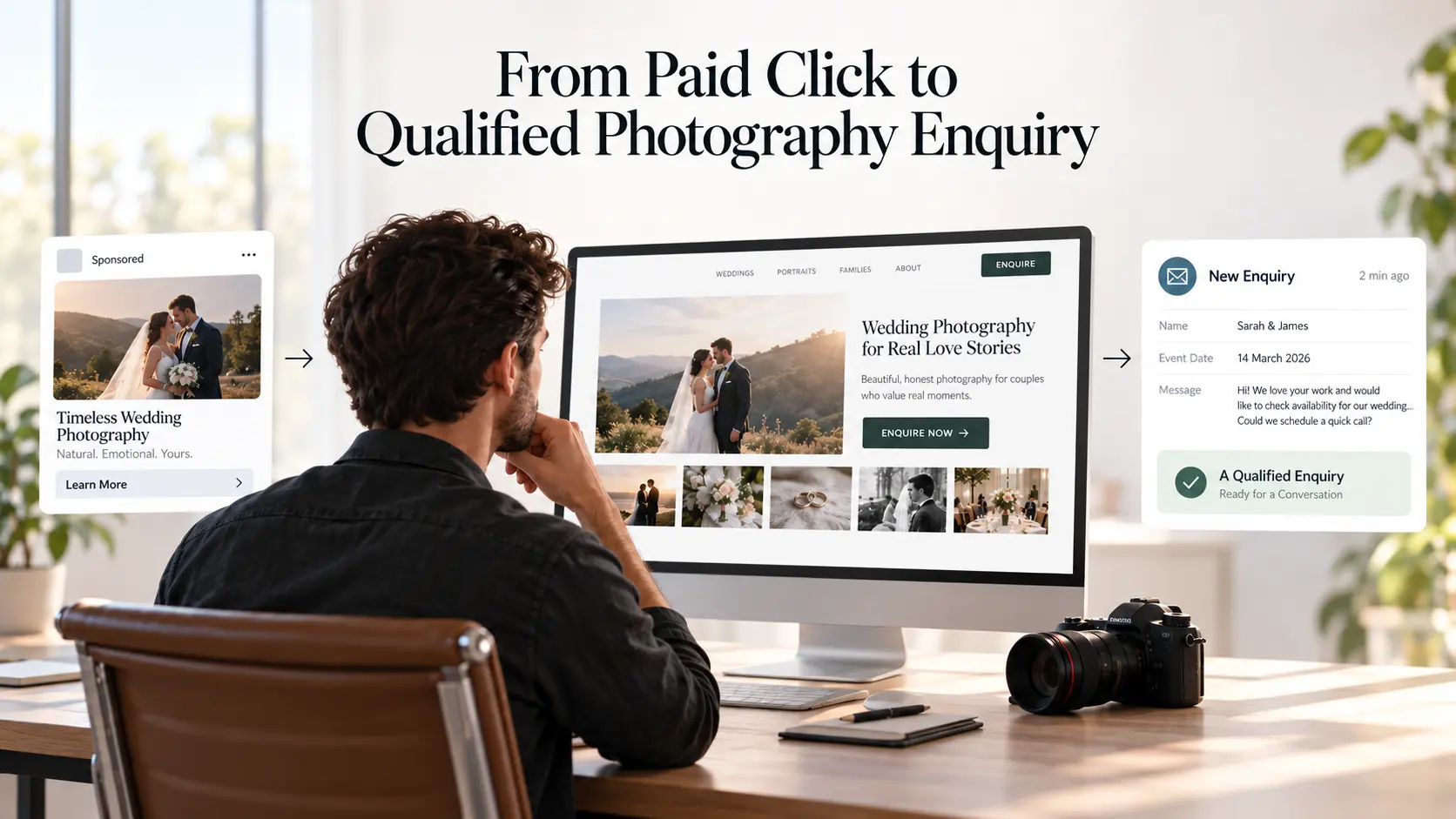
A person who clicks a photography ad is not browsing your website in the same way as someone who discovered your studio through a referral or searched your name directly.
They clicked because the ad made a specific promise.
Perhaps they were looking for a wedding photographer in their city. Perhaps your campaign promoted corporate headshots, newborn sessions, event photography or a seasonal portrait offer. They may already know what type of photography they need and could be comparing several photographers at the same time.
Sending that person to a broad homepage forces them to start their search again.
A strong photography landing page does something different. It continues the conversation started by the ad. The service is immediately recognisable, the work proves that you can deliver it, the buyer gets enough information to judge whether you are a realistic fit, and the enquiry action feels like the natural next step.
For paid traffic, that focus matters. The purpose of the page is not to show everything your photography business can do. It is to help the right visitor decide whether to enquire.
A photography landing page is not the same as your homepage
Your homepage has a broad job. It may introduce the studio, explain several photography services, show selected portfolio work, tell your story, link to galleries and pricing information, and help different types of visitors find the section relevant to them.
A photographer landing page for paid advertising has a much narrower job.
| Homepage | Paid-ad landing page |
|---|---|
| Serves several visitor types | Serves one campaign audience |
| Introduces multiple services | Focuses on the advertised service |
| Encourages exploration | Encourages a specific decision |
| Shows a broad portfolio | Shows proof relevant to the campaign |
| May have several CTAs | Uses one primary enquiry action |
| Explains the whole studio | Explains enough to qualify this requirement |
That does not mean every landing page has to be a stripped-down form with no personality. Photography remains a visual and trust-driven purchase. The visitor still needs to see your work, understand your approach and feel confident that a real professional business exists behind the advertisement.
The difference is that every section should support the same buying decision.
If your advertisement is for wedding photography, the page should feel like a wedding photography landing page from the first screen. A visitor should not have to navigate through portraits, food photography, maternity sessions and corporate events before discovering the work they originally clicked to see.
Match one landing page to one campaign intent
The relationship between the advertisement and the page is one of the first things we would inspect when a photography ads landing page generates clicks but weak enquiries.
The headline should continue the promise made before the click. The service, market and next action should remain consistent.
Consider a studio running separate campaigns for:
- destination wedding photography;
- corporate headshots;
- family portrait sessions;
- conference and event coverage.
Sending every campaign to the same generic portfolio page may be convenient for the studio, but it creates unnecessary interpretation for the visitor.
A person searching for corporate headshots needs to know whether you can photograph the required number of people, work at their office or another location, maintain a consistent visual style and deliver photographs appropriate for professional use. A wedding client needs completely different reassurance: coverage style, event experience, relevant celebrations, team capability, deliverables and possibly availability for multiple events.
The photography landing page should answer the questions created by that particular campaign rather than trying to represent your complete business.
Location deserves the same treatment. If an advertisement specifically targets a market or service area, make that relevance easy to confirm. You do not need to force the city name into every heading, but the visitor should not reach the enquiry form still wondering whether you actually work where their shoot will happen.
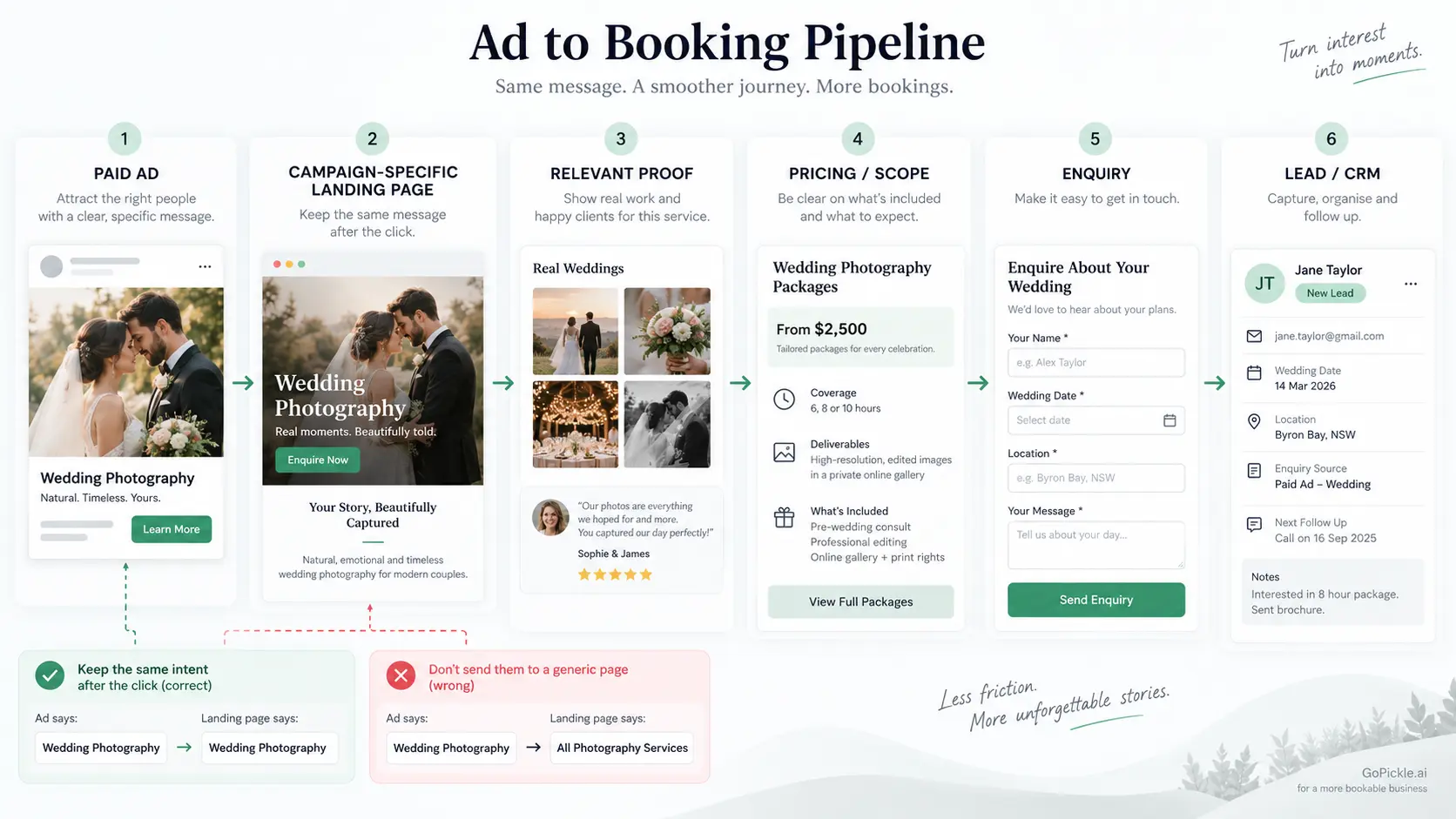
This campaign-to-page alignment is also useful beyond conversion. Google Ads itself treats landing-page relevance and usefulness as part of the landing-page experience it evaluates. More importantly for the photography business, the client gets what they expected instead of paying you for a click that immediately creates uncertainty.
Show proof that matches what the visitor wants to buy
Photographers understandably want to show their strongest photographs. On a paid landing page, however, your strongest photograph is not automatically your most useful proof.
Relevance matters.
If someone arrived through an advertisement for documentary wedding photography, show enough of that work to demonstrate how you handle real ceremonies, people, movement, difficult light and the flow of an event. A spectacular fashion portrait from another part of your portfolio may demonstrate skill, but it does not answer the buying question as directly.
The same principle applies to commercial and corporate work. A potential client looking for executive portraits may care more about consistency across ten or fifty people than a single dramatic editorial portrait. An event organiser may want to see crowded rooms, speakers, networking, stage lighting and sponsor details rather than unrelated studio work.
Curate rather than dump.
A photography website can hold the wider archive. The landing page should use enough photographs to establish style, consistency and relevant experience without turning the visitor's decision into an endless gallery session. Our guide to building a photography portfolio that converts visitors into enquiries goes further into the difference between showing good photographs and structuring a portfolio around client decisions.
Useful proof can also include client testimonials, complete-project previews, recognised clients where permission allows, published work, relevant venues or industries, and a concise explanation of how the assignment is handled. The objective is not to make the page look decorated with credibility signals. It is to reduce the specific doubts that could stop this visitor from continuing.
Give enough pricing and scope information to qualify the enquiry
One of the most expensive outcomes from a paid campaign is not necessarily getting no leads. It can be paying to generate enquiries from people who were never realistic prospects in the first place.
A photography landing page therefore needs some qualification before the form.
That does not mean every photographer needs to publish a complete rate card. The amount of pricing information that makes sense depends on the photography service.
For a standardised portrait session, publishing the complete package or a clear starting price may remove unnecessary uncertainty. Wedding photographers may be better served by showing a starting investment, common package direction or what typical coverage includes. Commercial photographers often need a custom quotation because production requirements, crew, retouching, deliverables and image usage can change substantially between assignments.
In that situation, “Contact us for pricing” is rarely the only information you can provide. Explain what determines the quote.
Our photography pricing website framework covers four practical approaches: complete prices, starting prices, realistic ranges and custom quotations.
Scope matters alongside price. Tell the prospective client what they are broadly buying. Coverage duration, locations, team structure, photographs or films delivered, turnaround expectations and optional products can all help the visitor understand whether the service resembles the requirement in their head.
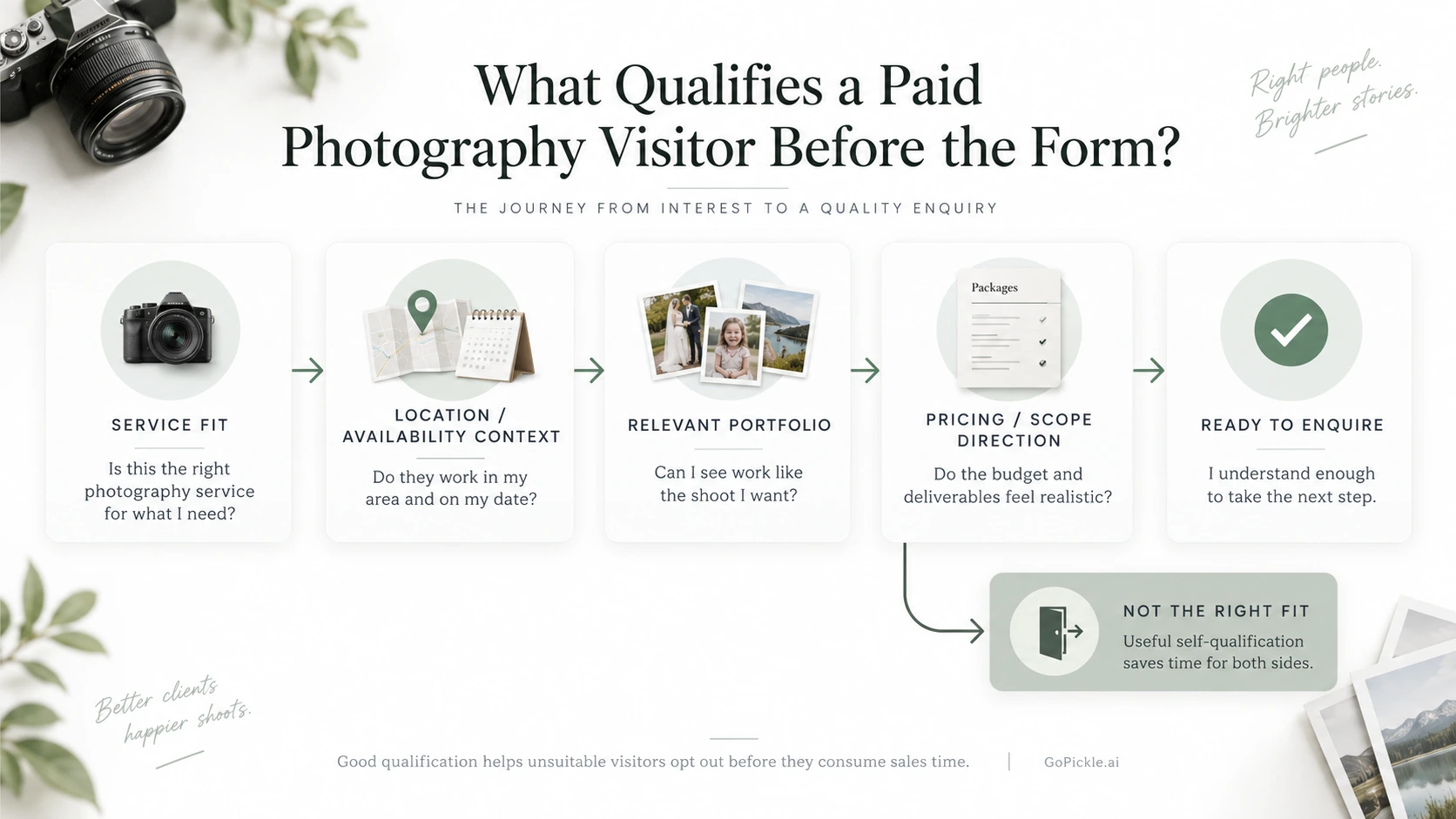
The goal is not to answer every question before the enquiry. It is to prevent obvious mismatches from entering the sales pipeline while giving suitable clients enough confidence to continue.
Make the enquiry action easy without making it meaningless
Once someone has seen the relevant work, understood the service and decided that the pricing or scope could suit them, do not make the enquiry form feel like the first administrative task of the booking.
You need enough information to begin a useful conversation, not enough information to produce the entire shoot plan.
For many photography services, a practical first enquiry can ask for the client's name, preferred contact details, photography requirement, date or approximate timeframe, location and a short description of what they need. A budget range may be useful when it genuinely helps the studio qualify the opportunity, but it does not need to be mandatory for every photography business.
More detailed questions can come later.
We cover this distinction in our guide to building a photography inquiry form before a lead reaches your CRM.
The CTA should also describe the action accurately. “Submit” says very little. Depending on the service, language such as “Check availability”, “Request a quote”, “Enquire about your wedding” or “Discuss your project” gives the visitor a clearer expectation.
Repeat the same primary action at sensible points throughout the page instead of introducing a different destination every few sections.
Mobile behaviour deserves particular attention. The form should be easy to complete on a phone, tap targets should be clear, images should not make the page unnecessarily heavy, and the visitor should not have to navigate around oversized galleries or intrusive overlays simply to contact the studio.
Once the enquiry arrives, it also needs somewhere reliable to go. GoPickle Lead Management for photographers keeps the requirement, source, ownership, follow-up and sales stage connected so a paid lead does not become another contact sitting inside an inbox or message thread.
Avoid navigation and portfolio overload
There is a popular landing-page rule that says every navigation option should disappear. For photography businesses, we would apply that more carefully.
A prospective client may reasonably want to verify the studio, read about your approach or inspect more work before sending an enquiry. Removing every route to additional information can sometimes reduce trust rather than increase focus.
The better principle is to remove unnecessary choices.
Your paid landing page does not need a large navigation menu inviting someone to explore every photography genre you have ever photographed. It probably does not need prominent links sending them to several social networks midway through the buying journey. It certainly should not present five unrelated CTAs competing for attention.
Keep secondary trust routes available where useful, but make the primary path unmistakable.
The same rule applies to photographs. More portfolio images do not automatically create more confidence. Once the visitor has enough proof to understand the quality and style of the service, another large gallery may simply delay the decision.
A photography landing page should feel complete without becoming a miniature version of the entire website.
Track the enquiry all the way to booked revenue
A form submission tells you that the landing page generated an enquiry. It does not tell you that the advertising generated good business.
This distinction becomes important once you start comparing campaigns.
Suppose one landing page generates substantially more enquiries, but most have unavailable dates, unsuitable requirements or budgets far outside the service you actually sell. Another produces fewer enquiries, but those prospects regularly progress to quotations and confirmed bookings.
The first page may appear stronger in an advertising dashboard while contributing less useful revenue to the studio.
At GoPickle, we recommend keeping enough lead context to follow the journey beyond the initial conversion:
Ad / Source → Enquiry → Valid Enquiry → Qualified Requirement → Quotation or Consultation → Booking
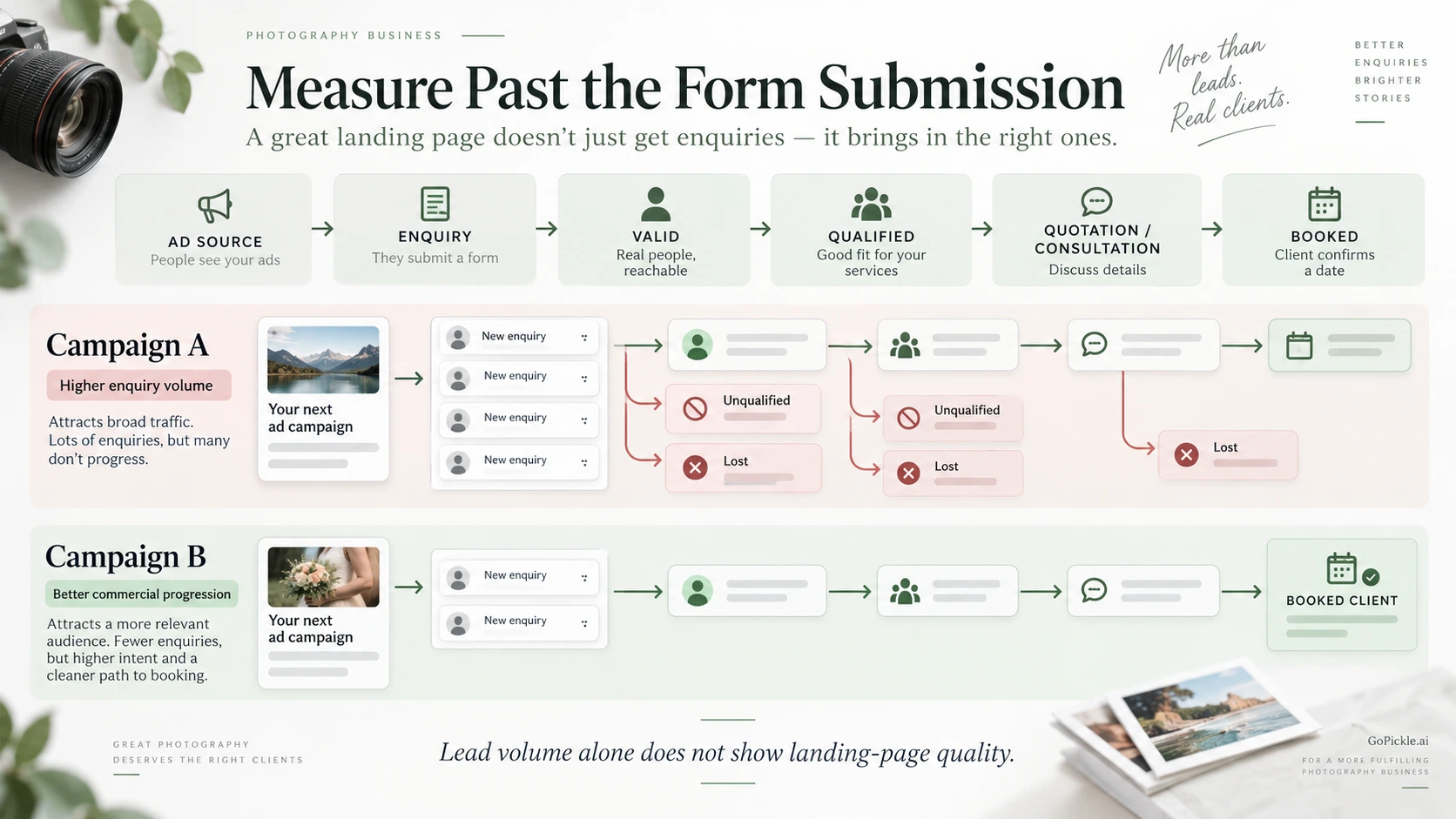
Record the lead source consistently. Keep the service requirement attached. Preserve lost or unqualified outcomes rather than deleting them. Then compare channels and landing pages by qualified opportunities, quotations, confirmed bookings and booked value rather than enquiry volume alone.
Our guide to measuring photography lead-to-booking conversion explains how separating enquiries, qualified leads, quotations and bookings produces a more useful view of marketing performance.
This is also where the landing page connects with the wider studio workflow. GoPickle's Get More Photography Bookings workflow brings lead capture, follow-up, quotations and confirmed bookings into the same commercial journey instead of treating lead generation as an isolated marketing activity.
Paid advertising can buy attention. The landing page determines what happens when that attention reaches your business.
A strong photography landing page does not need clever tricks. It needs a clear match between the advertisement and the service, relevant proof, enough commercial information to qualify the visitor, an enquiry action that is easy to complete, and a lead process capable of showing whether those clicks eventually became worthwhile bookings.
That is the standard we would use when evaluating a photographer landing page: not simply whether people filled in the form, but whether the page helped the right clients understand the offer and take the next useful step.