Revenue per Shoot Hour: The Metric That Exposes Underpriced Photography Work
Calculate photography revenue per hour using shoot hours and total labour hours. Compare packages, editing workload and capacity to find underpriced work.


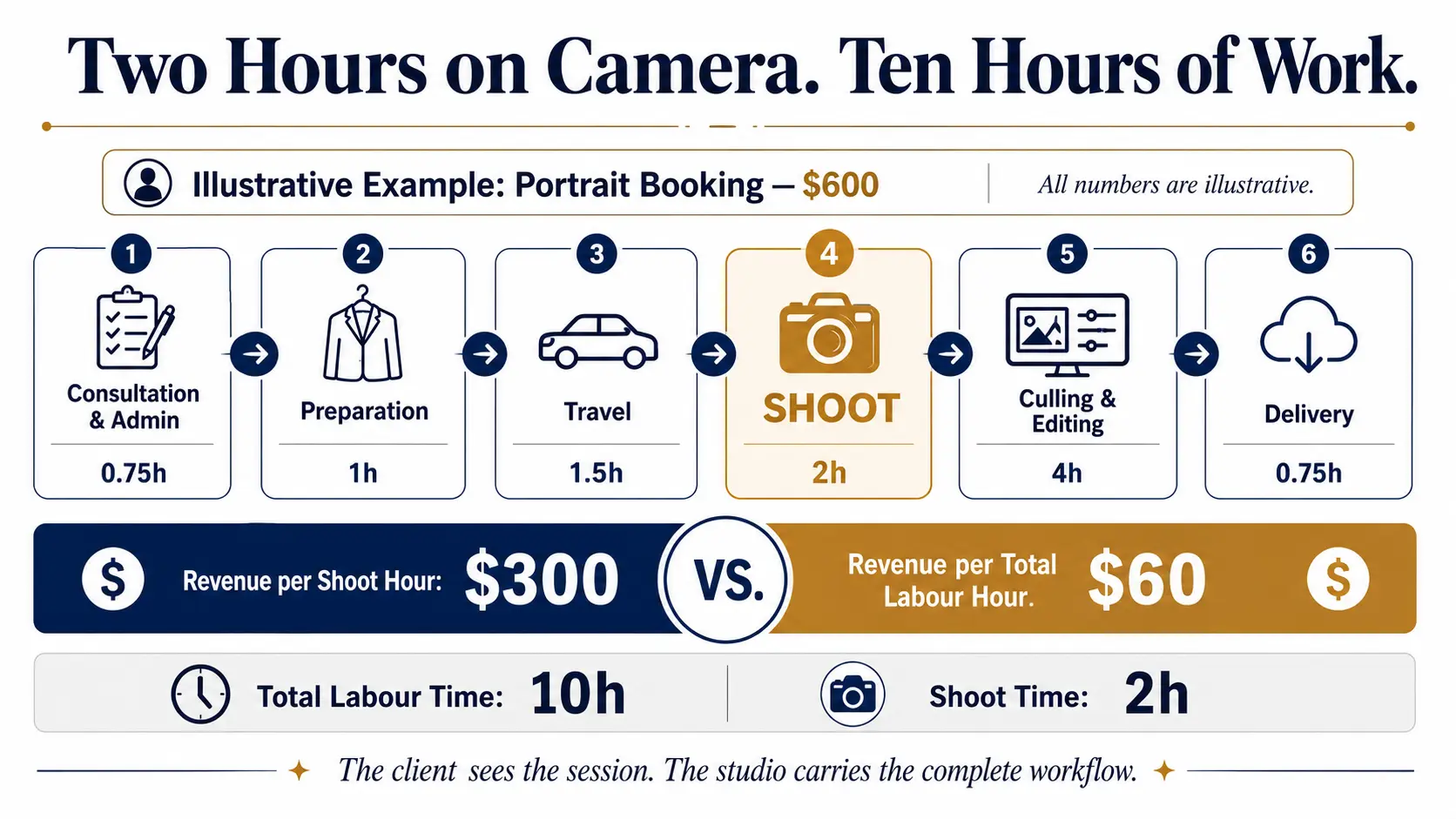
A photographer charges $600 for a two-hour portrait session. Look only at the time spent with the client and the booking appears to generate $300 of revenue per shoot hour. That can be a useful number. It is not the whole number.
Before the session there may have been an enquiry, consultation, scheduling, location planning and equipment preparation. The photographer travels to the shoot, photographs for two hours, returns to the studio, backs up the files, culls the session, edits the selected photographs, prepares the gallery and handles final client communication. What appeared to be a two-hour job may have consumed ten hours of working time.
The same $600 booking then produces $60 of revenue per total labour hour.
The figures are illustrative, not suggested market rates. Replace the currency and amounts with your own numbers whether you work in dollars, euros, pounds, rupees, dirhams, Australian dollars or another currency. The calculation does not depend on geography.
What matters is the difference between the two metrics.
Photography revenue per shoot hour tells you how much revenue is attached to scarce camera-facing time. Revenue per total labour hour tells you how much revenue the complete job produces for the time required to sell, prepare, photograph, process and deliver it.
For photographers trying to understand why a busy calendar is not producing the expected financial result, that gap can expose problems that package prices alone will never show.
Revenue per shoot hour and revenue per total labour hour answer different questions
Start with two calculations.
Revenue per shoot hour = Booking service revenue ÷ Shoot hours
Then calculate:
Revenue per total labour hour = Booking service revenue ÷ Total labour hours
For internal analysis, define booking revenue consistently. Use the agreed service value after discounts and refunds. If your prices include VAT, GST, sales tax or another tax collected for a tax authority, decide with your accountant whether that amount should be excluded from management revenue calculations, then use the same method across every booking you compare.
The same caution applies to pass-through expenses. If a commercial client reimburses $4,000 of model fees, studio hire and equipment rental, treating the entire reimbursement as photography revenue can make your hourly performance appear stronger without reflecting additional income from your photographic work. Separating service revenue from reimbursed production expenses usually produces a more useful management metric.
Shoot hours are relatively easy to identify. They are the hours spent photographing the assignment.
Total labour hours can include:
- enquiry handling and consultation;
- pre-production and planning;
- equipment preparation;
- location scouting;
- travel;
- photography;
- file transfer and backup;
- culling;
- editing and retouching;
- gallery preparation;
- album or print preparation;
- revisions;
- delivery;
- project administration and client communication.
This is also why we recommend explaining photography pricing in terms of the complete job rather than only the visible session. Our guide to explaining photography pricing without sounding defensive covers that client-facing conversation in more detail.
A short shoot can still create a long production job
Consider an illustrative $600 portrait booking.
| Work stage | Time |
|---|---|
| Consultation and administration | 0.75 hours |
| Preparation | 1 hour |
| Travel | 1.5 hours |
| Photography | 2 hours |
| Culling and editing | 4 hours |
| Delivery and follow-up | 0.75 hours |
| Total labour time | 10 hours |
The headline calculation is:
$600 ÷ 2 shoot hours = $300 revenue per shoot hour
The fuller calculation is:
$600 ÷ 10 total labour hours = $60 revenue per total labour hour
Neither figure tells you whether the booking is profitable. That requires another calculation.
The $60 still has to support the costs associated with the job and the wider business: equipment, insurance, software, assistants, studio overhead, marketing, outsourced editing, payment processing and other expenses. Our article on calculating photography profit margin for individual bookings addresses that separately.
This article is concerned with time utilisation.
A booking can have an acceptable profit margin but consume far more capacity than expected. Another may have an excellent revenue-per-hour figure but carry substantial direct expenses. You need both views rather than trying to turn one KPI into the answer to every pricing question.
Weddings, portraits and commercial photography should not be expected to behave the same way
One studio-wide hourly figure can become misleading because different photography services create very different workloads.
A portrait session may involve relatively little shoot time but considerable retouching. A wedding can involve ten or twelve hours of coverage, several photographers, travel, thousands of files and substantial post-production. A commercial product assignment might occupy only four hours in the studio while requiring a full day of pre-production and several days of compositing or retouching.
Consider three simplified examples:
| Assignment | Service revenue | Shoot hours | Revenue / shoot hour | Total labour hours | Revenue / labour hour |
|---|---|---|---|---|---|
| Portrait | $600 | 2 | $300 | 10 | $60 |
| Commercial product shoot | $2,400 | 4 | $600 | 24 | $100 |
| Event coverage | $2,400 | 8 | $300 | 20 | $120 |
Illustrative examples only. These are not market rates.
The table is useful precisely because the shoot duration does not explain the complete workload.
Commercial work adds another complication: licensing.
A photographer may create an image in one production day but license it for significant commercial usage. The usage fee can increase booking revenue without adding an equivalent number of production hours. That does not make the calculation incorrect. It shows that commercial value and labour time are not always directly proportional.
For that reason, commercial photographers may find it useful to compare both production revenue per labour hour and total project revenue including licensing.
The same principle appears in our guide to product photography pricing per image, SKU, day or project: similar amounts of camera time can represent very different production requirements and commercial value.
Count crew hours as labour hours
This is where studio-level calculations often become artificially optimistic.
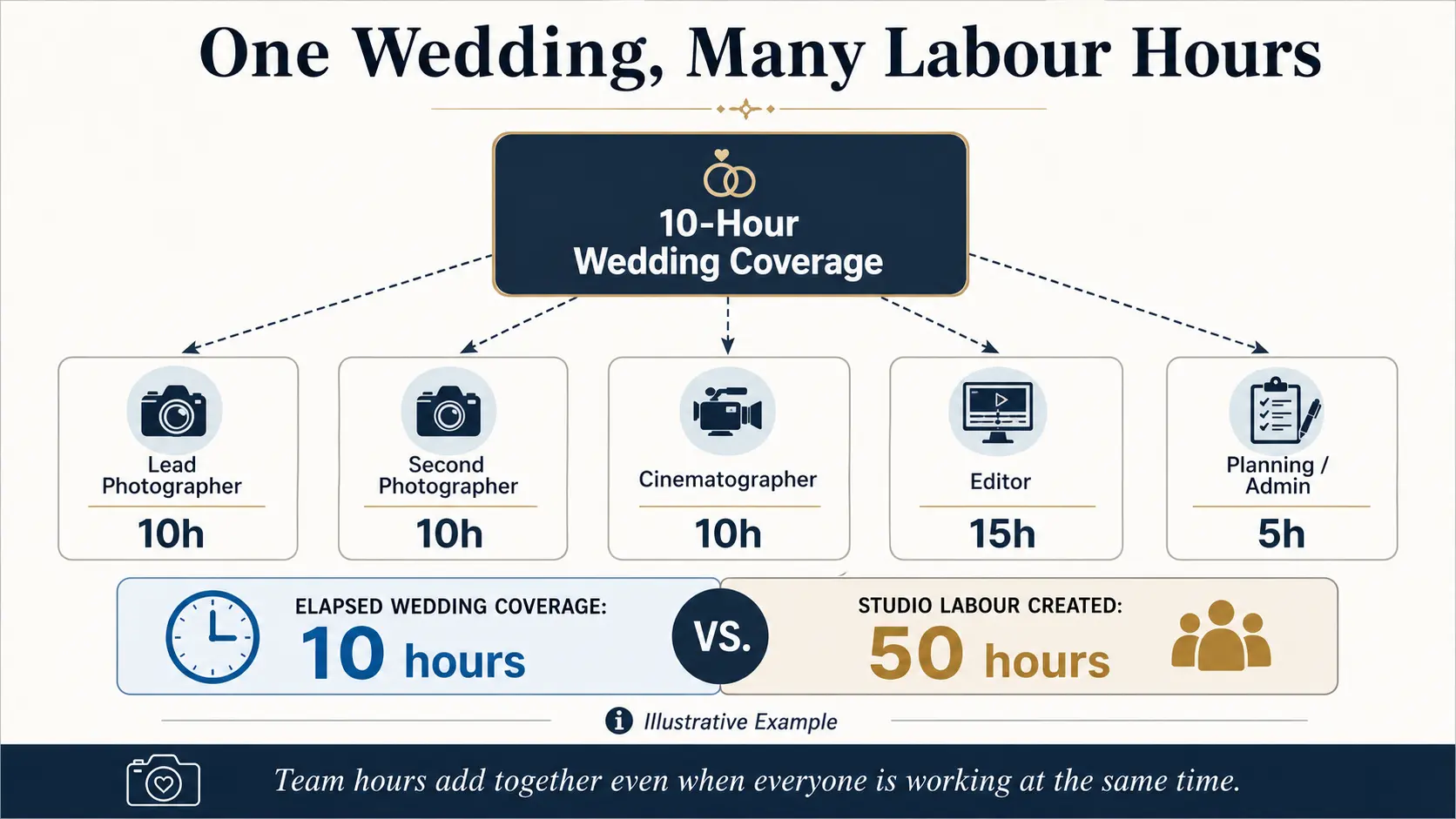
Suppose a wedding has ten hours of coverage.
If one photographer works for ten hours, that is ten photography labour-hours.
If a lead photographer, second photographer and cinematographer all work those same ten hours, the studio has used 30 labour-hours, even though only ten hours passed on the clock.
Add 15 hours of editing and five hours of planning and administration:
Lead photographer: 10 hours
Second photographer: 10 hours
Cinematographer: 10 hours
Editing: 15 hours
Planning and administration: 5 hours
Total: 50 labour-hours
This does not mean every hour has the same cost. A studio owner, assistant, cinematographer and editor may all have different compensation structures. Cost differences belong in profitability analysis.
For utilisation, however, counting the hours reveals the amount of human capacity the booking required.
You can make the calculation even more useful by separating total production labour from internal studio labour. If post-production is outsourced, the external editor's hours still form part of the work required to produce the assignment, but those hours are not consuming your internal editing team's capacity.
That distinction becomes valuable when deciding whether to hire, outsource or change workflow. The question is no longer simply “Are we busy?” It becomes “Which stage of this type of booking is consuming the capacity?”
Travel time matters even when the client reimburses the expenses
Destination work creates another common distortion.
A client can pay for every flight, train ticket, hotel room and airport transfer while the photographer still loses productive capacity to travel.
Imagine a one-day commercial assignment that requires travel the day before and the day after. Expense reimbursement makes the studio financially whole for the tickets and hotel, but it does not give those two calendar days back.
The same applies to destination weddings and international assignments.
Track travel hours when they materially restrict other work. If the photographer spends eight hours travelling, those eight hours are part of the labour requirement even though there was no camera work.
This does not mean every 20-minute local journey needs a complex costing system. The goal is enough accuracy to understand which assignments consume substantial hidden time.
Use the metric to compare packages that compete for the same capacity
Revenue per total labour hour becomes particularly valuable when reviewing package design.
Suppose two packages produce the following results:
Package A
Revenue: $3,000
Total labour: 45 hours
Revenue per labour hour: $66.67
Package B
Revenue: $4,000
Total labour: 80 hours
Revenue per labour hour: $50
Package B generates more revenue. It also requires 35 additional hours of work.
That does not prove Package B should be removed or increased in price. It tells you where to investigate.
Perhaps the premium package includes a film requiring heavy post-production. Perhaps clients receive substantially more edited photographs. Maybe the package includes an additional event, complex retouching or unlimited revisions that repeatedly exceed expectations.
Ask:
What are the additional 35 hours buying for the client and producing for the studio?
If those hours support healthy profit, stronger positioning or high-value client demand, the package may be working exactly as intended.
If the extra workload comes from poorly controlled revisions or an underpriced deliverable, the metric has exposed a design problem.
Editing can be the capacity problem even when the shoot calendar looks healthy
Photography businesses naturally manage availability around shoot dates because those commitments are visible. Editing capacity is easier to hide.
A studio can have free dates next week while editors are still processing the previous month's assignments. A two-hour session that creates six hours of post-production cannot be evaluated as a two-hour commitment.
Track actual post-production time across a meaningful sample of jobs.
You may discover that one package consistently produces too many files, one deliverable generates repeated revisions, commercial retouching takes substantially longer than estimated, or senior photographers are doing production work that could be delegated.
This is a capacity question before it becomes a hiring question.
Our article on how many weddings a photography studio can realistically take per month uses the same principle: available shoot dates do not equal available production capacity.
Similarly, studios considering team expansion should compare recurring utilisation before making fixed staffing decisions. Our freelance versus full-time photographer guide looks at that trade-off in more detail.
A low hourly result is not automatically a bad booking
Do not turn revenue per labour hour into a rule that every assignment must maximise.
A lower-hourly-rate job may be commercially sensible because it uses otherwise idle weekday capacity. A recurring corporate client may provide predictable work with very low acquisition costs. A smaller portrait booking may come from a long-term client relationship. A carefully selected editorial or commercial assignment may create portfolio value in a market the studio wants to enter.
Permanent staff change the calculation too. If employees are already being paid during a quiet period, profitable work that uses available capacity may make sense even if its hourly revenue is below the studio's peak-season average.
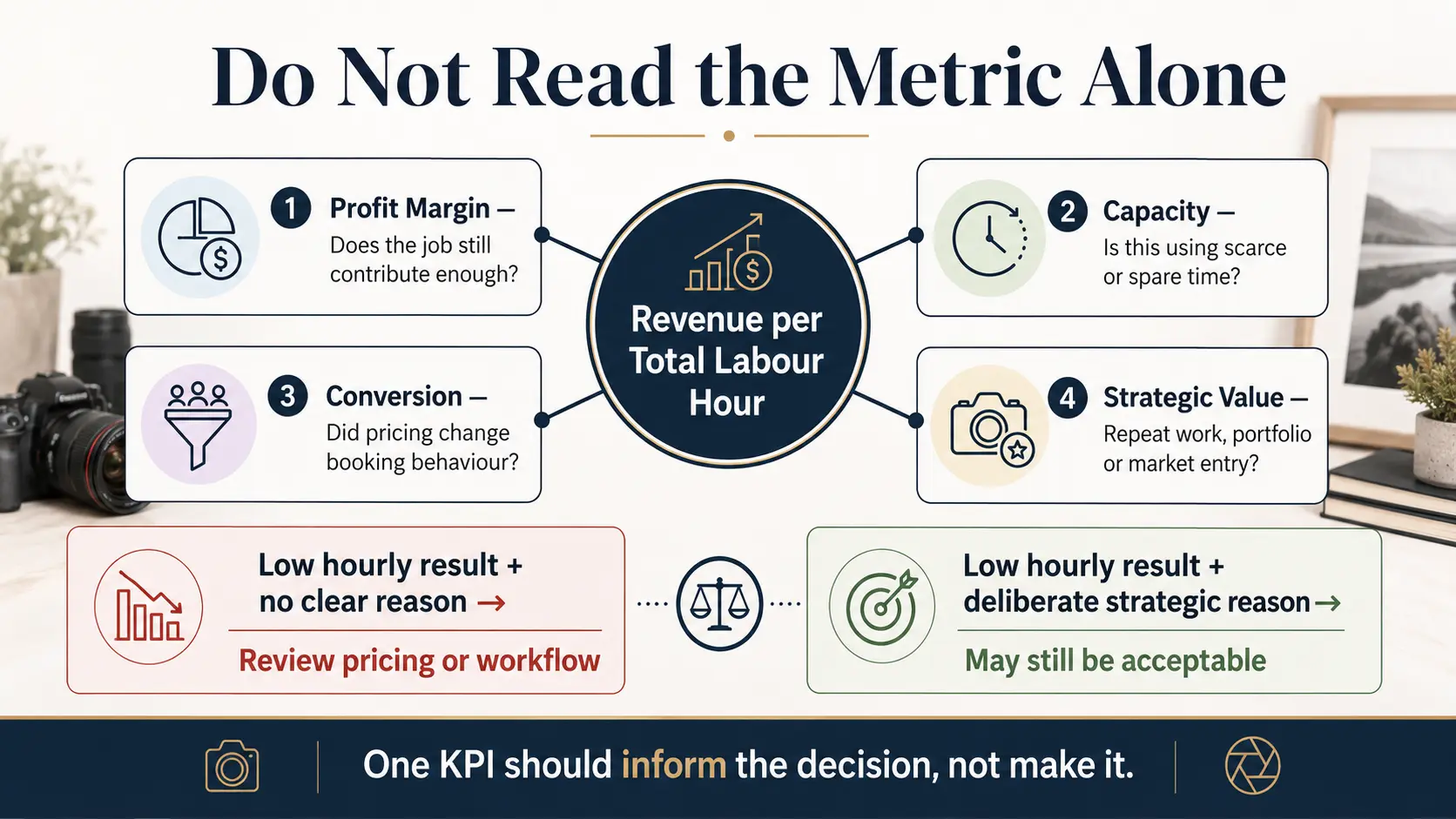
The important distinction is between a deliberately accepted lower result and an unknown lower result.
If you choose to accept the job because it serves a strategic purpose, the metric is helping you make the decision.
If you thought the job was highly efficient because it involved only two hours of shooting and later discover it consumed fifteen hours, the metric is exposing something you did not previously understand.
Review revenue per hour with profit, capacity and conversion
Revenue per labour hour works best beside other photography business metrics.
Look at:
Profit margin: After direct costs and overhead allocation, does the booking contribute enough?
Capacity: Is the job consuming scarce peak-season resources or unused capacity?
Conversion: If you increase the price or reduce scope, what happens to suitable enquiries?
Service mix: Does this type of work complement or compete with your highest-priority services?
Strategic value: Is there a deliberate reason to accept weaker short-term hourly economics?
Payment behaviour: Is the booking valuable on paper but difficult or slow to collect?
One KPI should inform the decision, not make it.
This is particularly important for studios operating across several markets or photography genres. A New York commercial photographer, Dubai event studio, London portrait photographer and Bengaluru wedding studio should not be expected to produce the same hourly figure. Their costs, currencies, buying behaviour, labour structures and available capacity are different.
What they can use is the same method.
Compare their own jobs against their own workload.
Estimated hours help you price. Actual hours help you improve the next price.
You can estimate total hours while preparing the quote, but the stronger information comes after delivery.
For representative bookings, record:
Booking revenue → planning → travel → shoot → editing → revisions → delivery → total labour hours
Then compare the estimate with what actually happened.
You do not need to record every minute indefinitely. A consistent sample is enough to expose recurring differences between what a package is supposed to require and what it really requires.
If a portrait package was designed around six total labour hours and repeatedly consumes ten, something needs review.
If a commercial job routinely requires substantially more retouching than the quotation assumes, pricing or scope needs review.
If your highest-value wedding package creates excessive internal editing pressure, workflow or staffing may need review.
A structured booking record makes those comparisons easier because you can trace the workload back to what was actually promised. GoPickle Booking Management keeps clients, events, services, deliverables, crew, quotations, invoices and other booking context connected around the same assignment.
GoPickle is not an accounting system or employee time-tracking platform. The value here is having enough operational context around each booking to understand why one job consumed more studio time than another.
The client books the photography. The studio has to deliver the entire job.
Revenue per shoot hour matters because camera time is finite.
For a solo photographer, there are only so many sessions or assignments that can fit into a working week. For a larger studio, there are still limits created by photographers, editors, crew, equipment and delivery capacity.
But the shoot is only one part of that capacity.
A short session can be inefficient. A long event can be highly efficient. A premium commercial assignment may create significant value without requiring proportionally more production time. A lower-hourly booking may still deserve space in the calendar for a deliberate business reason.
The useful comparison is not between your number and somebody else's supposed industry average.
It is between what you thought each booking required and what it actually required.
Calculate revenue per shoot hour. Then calculate revenue per total labour hour. The distance between those numbers tells you where to look next.