Rent vs Buy Photography Equipment: A Business Case for Growing Studios
Compare renting vs buying photography gear using utilisation, total ownership cost, rental logistics, backup risk, cash flow, resale value and break-even usage.

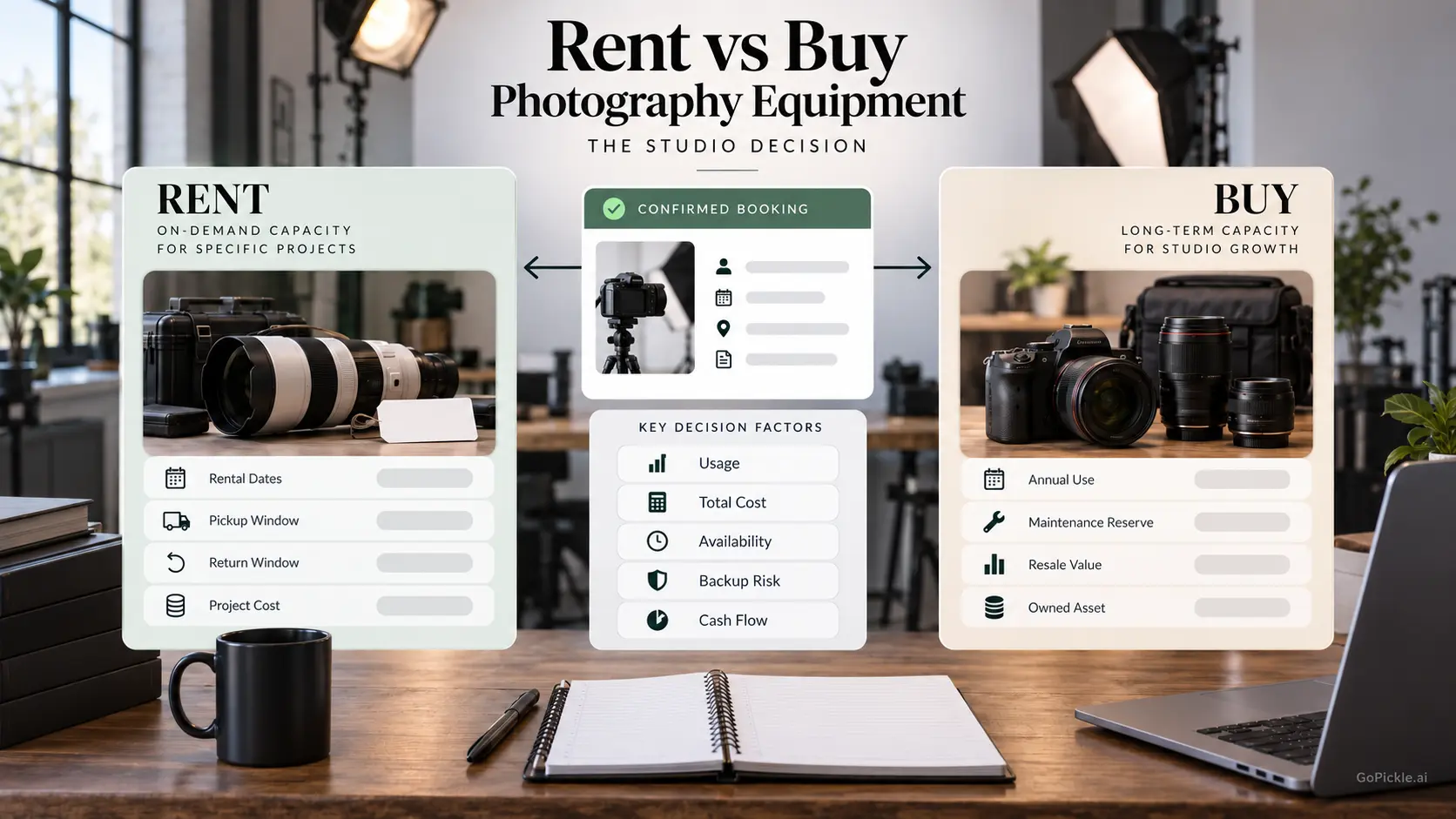
A new lens can be easy to justify when a confirmed job needs it next weekend. The harder question is whether the studio should still own that lens two years later.
For a growing photography business, the rent vs buy photography equipment decision should be treated as a capacity and cash-flow decision, not a gear preference. The useful questions are how often the equipment will be used on paid work, what it costs to keep available, what happens when it fails, how easily an equivalent can be rented, and what else the purchase money needs to fund.
Start with utilisation, not desire
Begin with the bookings your studio actually accepts. Look back over the previous 12 months and forward across work that is reasonably visible. For each item you are considering, count the days on which that exact capability was required. Do not count every shooting day simply because the equipment could have been used.
A wedding studio may use two standard camera bodies and a 24–70mm lens constantly, but need a long telephoto only for a few ceremonies. A commercial photographer may use the same lighting heads every week while renting a tilt-shift lens or specialist modifier only when the brief calls for it. An event studio may own enough cameras for normal coverage and rent extra identical bodies during peak weeks.
| Gear role | What it means | Typical acquisition logic |
|---|---|---|
| Core production kit | Required across much of paid work | Strong ownership candidate |
| Backup / redundancy kit | Protects booked work if a primary item fails | Evaluate against interruption risk |
| Peak-capacity kit | Needed when jobs or crews overlap | Compare seasonal rental with year-round ownership |
| Specialist kit | Required for narrow or uncommon briefs | Strong rental candidate until usage becomes repeatable |
The useful metric is not “How much do I like this?” It is “How many revenue-producing or risk-protecting days will this asset serve?”
Calculate the true cost of buying photography gear
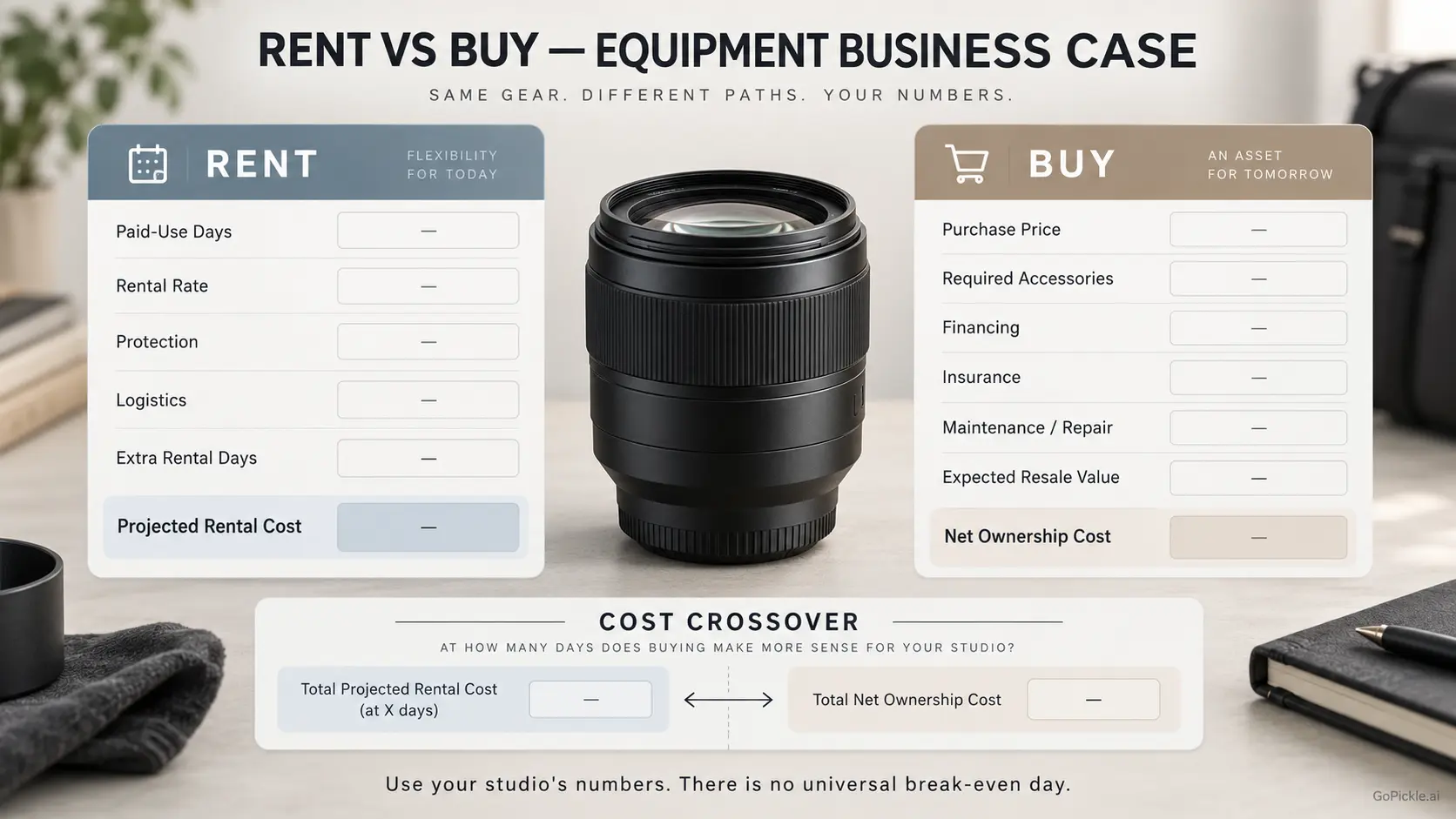
The store price is only the first line of the purchase decision. For a realistic photography equipment rental vs purchase comparison, build an ownership cost over a defined period, such as two or three years, using the same period for rental.
Add the accessories required to make the equipment production-ready, financing cost if you are borrowing, equipment insurance where applicable, expected maintenance and repair, and any storage or handling cost that materially changes as the kit grows. Then subtract the amount you reasonably expect to recover when the equipment is sold.
Net ownership cost = purchase price + required accessories + financing + insurance + maintenance/repairs + other ownership costs − expected resale value
This is an operating decision, not a tax-depreciation formula. Accounting and tax treatment differs by jurisdiction, so keep statutory depreciation and deductions with your accountant. If you are still building the wider cost base of the business, our guide to the photography business break-even point is a useful companion because gear ownership ultimately has to be supported by profitable bookings.
Calculate the recurring cost of renting camera gear
Rental looks simple because it arrives as a per-day or per-week price. The real cost may also include delivery or pickup, damage protection or insurance, deposits or payment holds, applicable taxes and extra days needed because collection and return do not line up perfectly with the shoot. Your team also spends time reserving, collecting, inspecting, configuring and returning the kit.
Rental agreements can place responsibility on the renter for late returns, lost accessories or damage, so those terms matter even if they do not become costs on every booking. For an important paid assignment, the cheapest quoted rental is not necessarily the cheapest workable rental if it arrives too late to test.
When equipment is hired solely because a particular booking requires it, treat it as a direct job cost in your internal profitability analysis. Our guide to photography expense tracking explains why a rented item for one client should be handled differently from equipment the studio owns and uses across many projects.
Availability and failure risk can change the answer
Pure break-even maths assumes the equipment is available exactly when needed. Photography businesses operate under deadlines, travel, venue access and events that cannot be repeated.
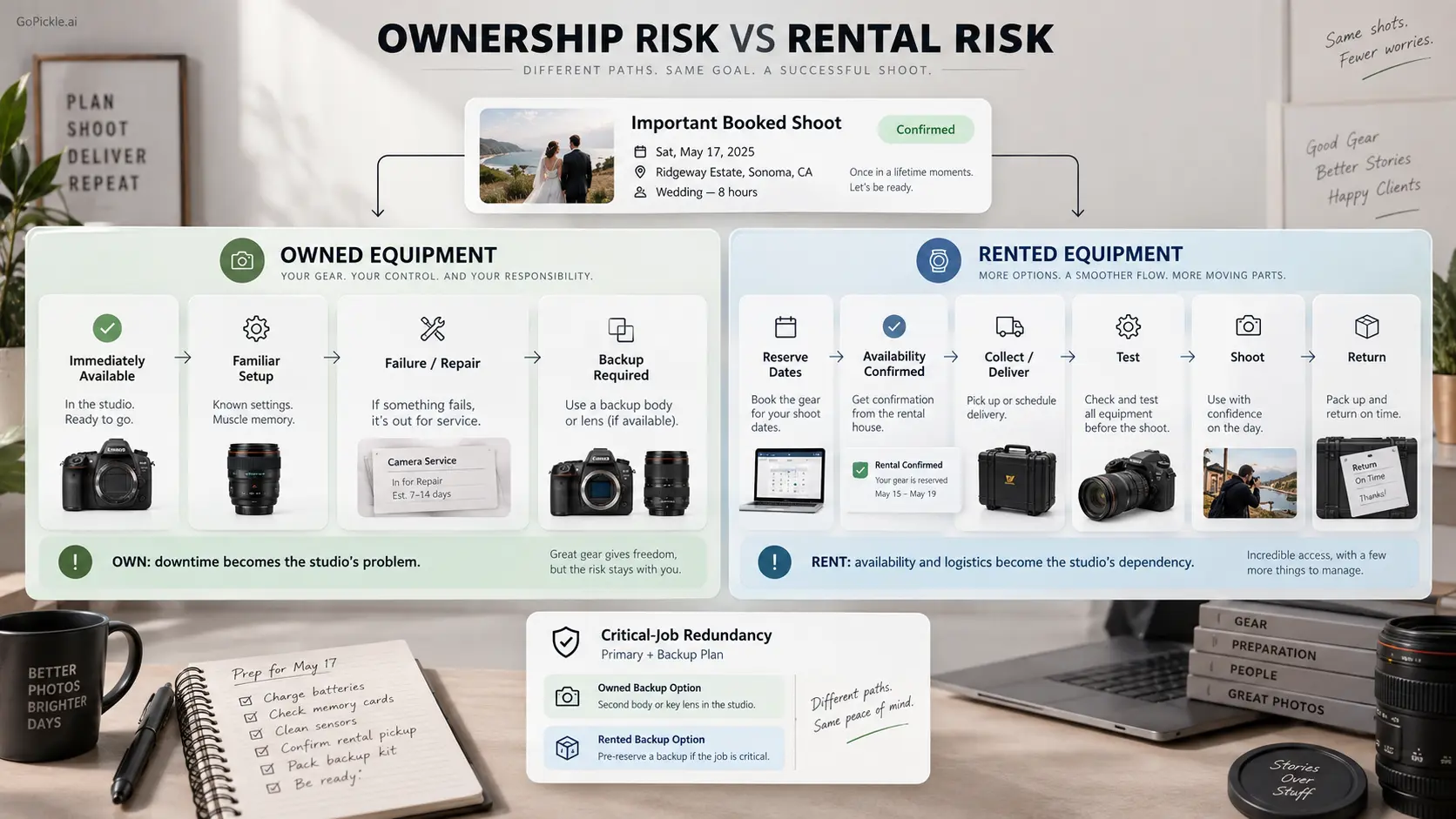
Ownership gives the studio immediate control over a familiar item, but it also moves failure risk onto the business. If an owned item is critical to delivery, ask what happens during repair. Do you already own a substitute? Can a local rental house replace it quickly? Would the studio have to change the crew plan or turn down a booking?
Renting shifts maintenance of the rental inventory to the provider, but creates a different dependency: the right item must be available for the right dates, arrive in working order and leave enough time for testing. This matters most during peak periods and for specialist equipment with limited local supply.
For multi-crew studios, equipment capacity and people capacity should be planned together. Adding another camera package does not create another deployable team if the right photographer or assistant is unavailable. GoPickle's Crew Management for photographers helps studios plan availability and event assignments around confirmed work.
Cash flow and flexibility matter as much as lifetime cost
A purchase may be cheaper over three years and still be the wrong move this month.
Buying converts available cash, or borrowing capacity, into an asset that may earn over many future jobs. Renting keeps the cost variable and closer to the booking that created the requirement. For a studio with uneven seasons, staged client payments or substantial crew and album costs, that timing difference can matter more than a small theoretical saving in total ownership cost.
Before buying, place the payment on the same calendar as expected client receipts and other commitments. A studio with a strong forward pipeline may still have weak near-term liquidity if most clients have paid only advances. The photography studio cash-flow forecast shows how to separate booked revenue from money actually expected to arrive.
Financing changes when cash leaves the business; it does not make the equipment cheaper. Compare the full financing cost, not only the monthly instalment.
Specialist gear vs core kit: a hybrid model usually works better
For most growing studios, the strongest answer to rent camera gear vs buy is a hybrid acquisition model.
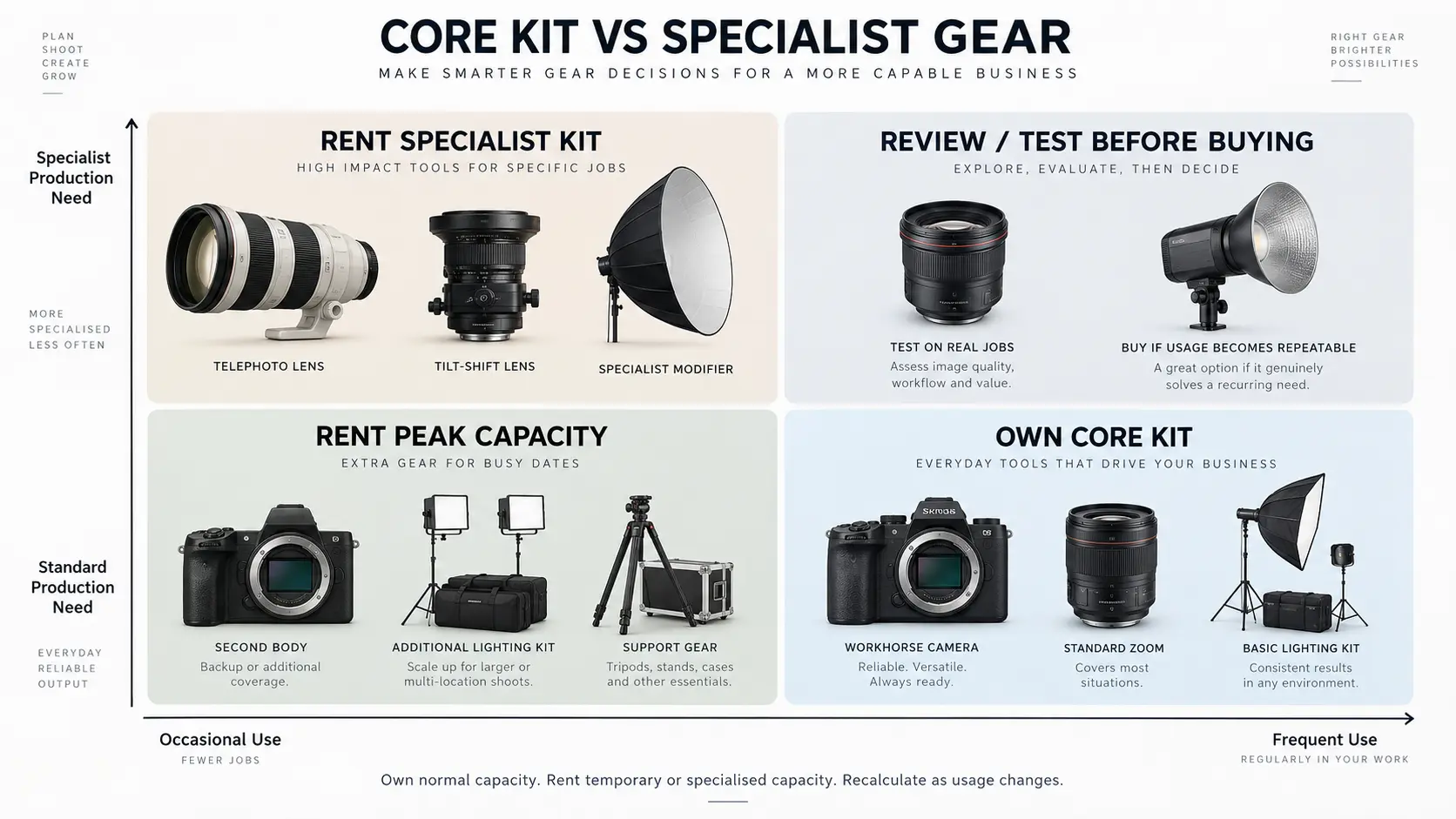
Own equipment that defines normal production capacity and is used repeatedly enough to justify immediate availability. Rent equipment that expands capability for a particular brief, adds temporary capacity during busy periods or lets the studio test a new workflow before making a permanent investment.
A durable light stand used across most assignments may be a better ownership decision than an expensive lens brought out only for occasional specialist work. A second identical camera body may make sense even if it does not create extra revenue directly because it protects a high-value event workflow from a single equipment failure. Conversely, a technically impressive specialist item may remain a rental for years if clients rarely require it.
Use a rent-vs-buy worksheet based on annual usage
You do not need an industry benchmark for how many days justify a purchase. You need your studio's numbers.
| Input | What to enter |
|---|---|
| Planning horizon | 12, 24 or 36 months |
| Expected paid-use days | Days the item is genuinely required |
| All-in rental cost per use day | Rate plus protection, logistics and recurring charges |
| Purchase price | Actual supplier price |
| Required accessories | What is needed to deploy the item |
| Financing cost | Total financing cost over the horizon |
| Insurance / maintenance / repair | Expected ownership costs |
| Expected resale value | Conservative value at the end of the horizon |
| Rental availability risk | How easy it is to secure the item for your dates |
| Cash-flow impact | What the purchase would remove from working capital |
Then calculate:
Projected rental cost = expected rental use across the period × all-in rental cost per use
Net ownership cost = total ownership costs across the period − expected resale value
An illustrative example makes the logic clear. Suppose an item costs 6,000 currency units to buy, requires 400 in accessories and is expected to incur 700 of ownership costs over the planning period. If you expect to resell it for 3,100, the net ownership cost is 4,000. If the realistic all-in rental cost is 200 per use day, the simple cost crossover is 20 use days over that same period. Those figures are illustrative only; replace every number with your own supplier quotes and expected usage.
Do one more check before deciding. If ownership appears cheaper at 20 days, ask how confident you are that those 20 days will exist. Confirmed recurring work deserves more weight than hoped-for expansion. For gear tied to larger productions, also look at the contribution left after direct costs, not just booking value. Our guide to calculating photography profit margin on every booking shows how equipment hire, crew, travel and other production costs change the economics of the job.
Make gear earn its place in the business
At GoPickle, we would not treat equipment ownership as a badge of studio maturity. A growing photography business needs enough reliable capacity to fulfil the work it sells, plus a sensible way to expand when a project falls outside that normal capacity.
The practical pattern is simple: own the core kit that works repeatedly, protect critical jobs with planned redundancy, rent specialist tools and temporary capacity, and revisit the maths when booking volume changes. GoPickle's Booking Management for photographers keeps events, services, crew, quotations, invoices and payment context connected around confirmed work. It is not an equipment asset register or an accounting system, but a reliable booking record gives the studio better operational evidence for how many jobs are coming, how many crews need to be deployed and when client money is due.
The best gear decision is the one that gives the studio the capacity it needs without quietly weakening cash flow or margin.