Late Photo Delivery: How to Communicate, Recover Trust and Reset the Production Plan
Running late delivering client photos? Learn how to identify the production blocker, reset the delivery date, communicate clearly and protect other deadlines.


A photography delivery problem usually becomes visible before the promised date actually passes. The wedding is still halfway through the main edit. A commercial job has reached retouching later than planned. Client selections arrived several days behind schedule. An external editor has missed an internal handoff. Or the gallery may technically be close to finished, but quality control, export and upload still require more time than the studio has left.
That is the point to act.
When a photographer is late delivering photos, the client communication matters, but communication alone does not solve the problem. A reassuring message followed by another missed date usually damages confidence more than one properly planned reset. The studio needs to work on two tracks at the same time: give the client a clear, credible update and rebuild the production plan around the real work remaining.
This guide begins at the moment an agreed photo delivery date becomes unsafe. If you are still deciding what turnaround to promise in the first place, start with our guide to setting a realistic photography turnaround time. Here, the promise already exists and the studio needs to recover it.
Recognise the delivery risk before the deadline passes
The worst time to discover a delivery problem is when the client asks, “Weren’t the photos supposed to arrive today?”
A studio should be able to see the difference between a project that is comfortably progressing and one whose promised date is becoming exposed. That requires more than knowing that a wedding is “being edited.” You need to know the current production stage, the work remaining, who owns that work, whether anything is blocked and how much usable production capacity exists before the deadline.
For example, a gallery due Friday may sound safe on Monday. But if 2,500 photographs still require the main edit, detailed retouching has not started, the senior editor is shooting on Wednesday and another contracted delivery is due Thursday, the risk already exists. Waiting until Friday does not make the estimate more accurate; it simply removes the opportunity to manage the problem properly.
This is why we recommend separating the client-facing promised date from an earlier internal production target. The internal target creates room for QC, export, gallery preparation and unexpected rework instead of treating the final client deadline as the day the editor should finish.
A photography delivery deadline dashboard can help make this visible across multiple bookings by tracking promised dates, internal targets, production stages, blockers and forecasts in one place.
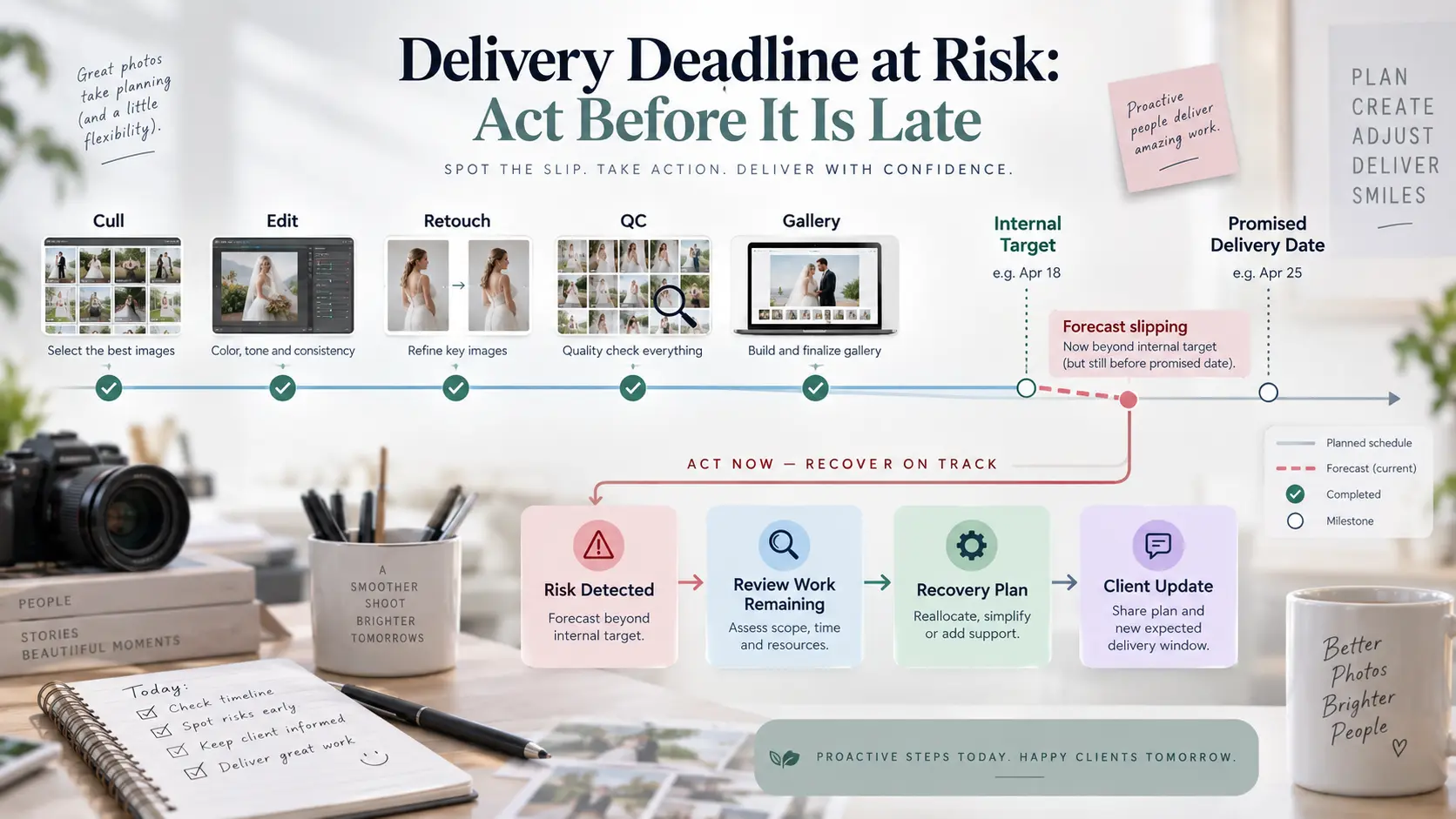
The moment the forecast moves beyond the promised date, treat the booking as a delivery risk. Do not wait for the date to become officially overdue before changing the plan.
Find the real production blocker before sending a new date
“Editing is delayed” is a description, not a diagnosis.
Before sending a photo delivery delay client message, identify exactly why the job is moving late. The answer determines both the recovery plan and the date you can responsibly give the client.
A wedding may be delayed because culling took longer than expected. Another may be fully colour-corrected but waiting for 40 detailed retouches. A portrait session may not actually be blocked inside the studio at all because the client has not submitted final selections. A commercial project may be sitting idle while an agency approves crops. A multi-photographer event may be waiting because one memory-card handoff never reached the main editor.
Break the remaining job into actual work:
| Current issue | What to establish | Recovery question |
|---|---|---|
| Editing backlog | Hours of active work remaining and competing deadlines | Can capacity be reassigned without breaking another promise? |
| Retouching bottleneck | Number and complexity of detailed edits | Can eligible work be distributed to another trusted editor? |
| Client dependency | Selection, approval or information still missing | Has the client been clearly told what action is required? |
| External editor delay | Files received, work completed, revised handoff date | Should the job be reassigned or partially recovered internally? |
| QC or export problem | What failed and what must be repeated | How much additional production time is actually required? |
| Gallery preparation | Upload, organisation, access or delivery work remaining | Is production finished but the final handoff still incomplete? |
If several jobs are competing for editing time, use the principles in our photography editing backlog triage guide. The objective is not to push the loudest client to the front. It is to understand contractual deadlines, blockers, project age and the consequences of moving each job.
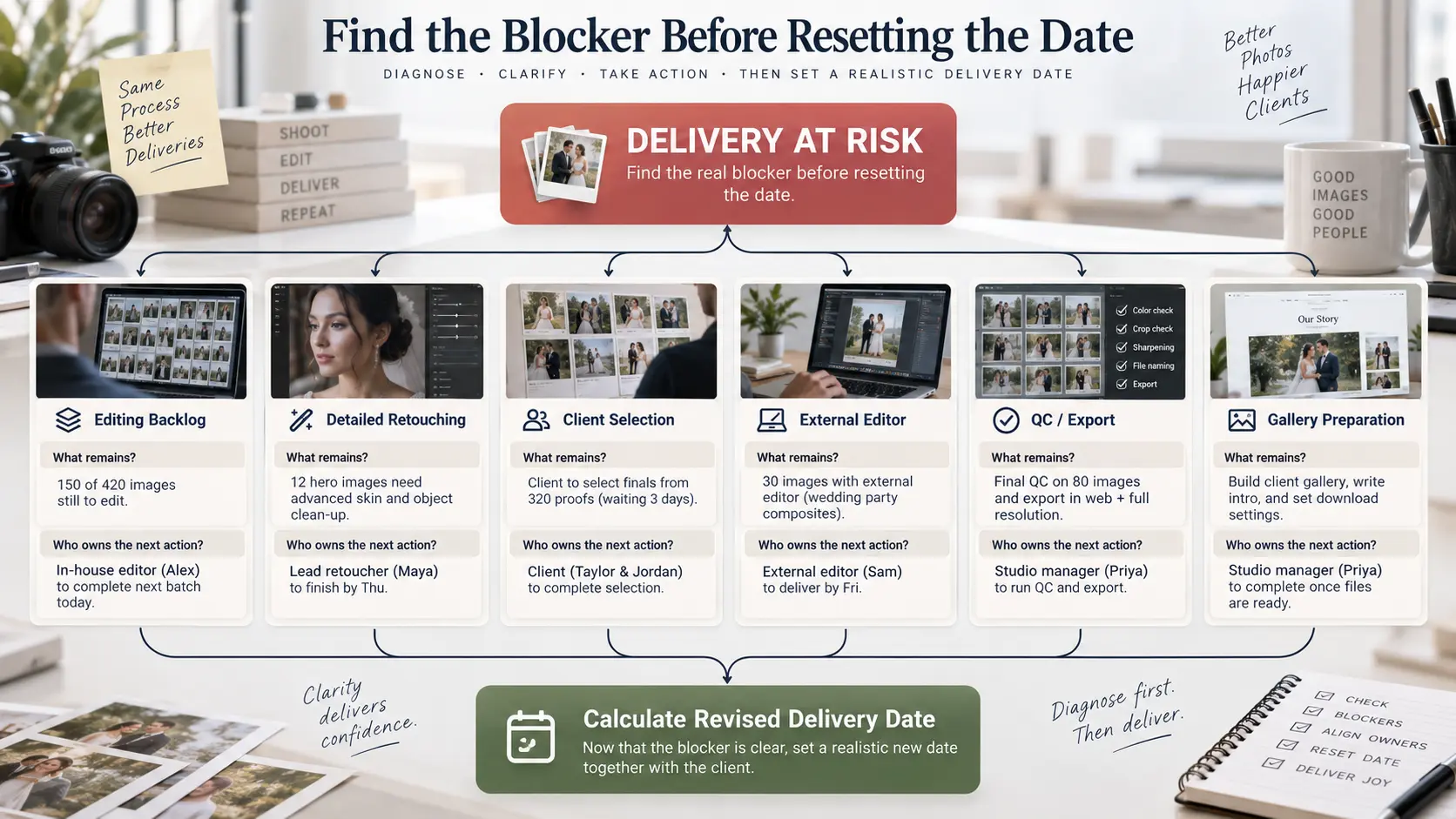
Once the blocker is known, estimate the remaining work again from the current point. The old plan is no longer useful simply because it was the original plan.
Set a new delivery date based on capacity, not optimism
A photography turnaround delay often becomes worse because the photographer tries to soften the first disappointment with an aggressive new promise.
“We just need another day.”
“Definitely by the weekend.”
“Almost done.”
Those statements may feel reassuring when they are sent, but they create another client expectation. If nobody has calculated the remaining work, they are guesses.
Build the revised delivery date from what is actually left: production hours remaining, available editor capacity, known approvals, quality control, export, upload and a reasonable operational buffer. If the project needs ten hours of active work and the responsible editor has only three available hours per day after existing commitments, promising tomorrow does not make the studio more responsive. It makes a second delay likely.
This matters particularly when wedding photos are delayed. Large wedding galleries contain enough production stages that “nearly finished” can still represent meaningful work. The main edit may be complete while retouching, consistency review, duplicate checks, export and gallery QC remain unfinished.
Give the client the date you believe you can keep, not the earliest date that sounds acceptable.
Tell the client what changes and what does not
Clients usually need a smaller amount of information than photographers think. They do not need a detailed explanation of every folder, editing preset, staff absence or technical problem inside the studio. They do need to know that you are aware of the delay, what they should now expect and whether they need to do anything.
A useful photographer delivery communication update contains four things: the project being discussed, the fact that the original timeline has changed, the revised delivery commitment and any client action that is required.
For example:
I wanted to update you before the planned gallery delivery date. Your photographs are currently in final editing, but we need additional production time to complete the remaining work and quality review to the standard intended for your gallery. The revised delivery date is Thursday, 15 October. Nothing further is required from you, and I will update you again if anything materially changes before then.
The wording will naturally vary according to the situation. If the studio caused the delay, do not hide behind vague language. If the job is waiting on a client selection, state that clearly instead of implying that editing is running late. If only one deliverable has moved, make sure the client knows that the rest of the booking is unaffected.
Avoid announcing internal production details that do not help the client make a decision. “Our freelance editor's laptop crashed and another editor is on three weddings this week” may be true, but the client still needs to know what happens to their work.
The most useful message reduces uncertainty.
Use partial delivery only when it genuinely helps
When a full gallery is late, sending part of the work can sometimes improve the situation. It can also make production slower.
A wedding couple may appreciate a small set of finished photographs while the main gallery is completed. A corporate client may urgently need five approved images for a campaign while the broader event collection can follow. A portrait client may benefit from having one time-sensitive photograph delivered first.
But partial delivery should be a deliberate branch of the recovery plan, not an improvised attempt to make the client stop asking.
Ask whether producing the partial delivery will materially help the client, whether those photographs can be finished to the studio's normal standard and whether creating them will delay the main job further. If preparing 30 additional preview photographs takes six hours away from the final gallery, the gesture may create a worse production problem.
Our wedding sneak peek workflow covers this distinction in more detail. A preview works best when its scope is controlled, clearly labelled and closed once delivered.
When finished photographs are ready, a professional Client Gallery can also give the client one clear place to receive the work rather than creating a trail of temporary folders, chat attachments and replacement links.
Protect other contracted deadlines while recovering this one
One late delivery can easily create three more.
A studio discovers that Wedding A is behind, so every editor is moved onto it. Wedding A is rescued, but Portrait B and Commercial Job C lose the production time that had already been allocated to them. A week later, both become emergencies.
Recovery planning therefore needs a queue-wide view.
Before borrowing capacity from another project, check its promised date, internal production target, work remaining and flexibility. Some work can move safely. Some cannot. A corporate campaign tied to a launch date may have almost no scheduling tolerance. Another wedding with several weeks remaining may be able to give up one production day without creating meaningful risk.
This is where a photography post-production status board becomes useful. Instead of treating each late job in isolation, the studio can see culling, editing, retouching, QC and delivery across every active project and make capacity decisions with the complete queue visible.
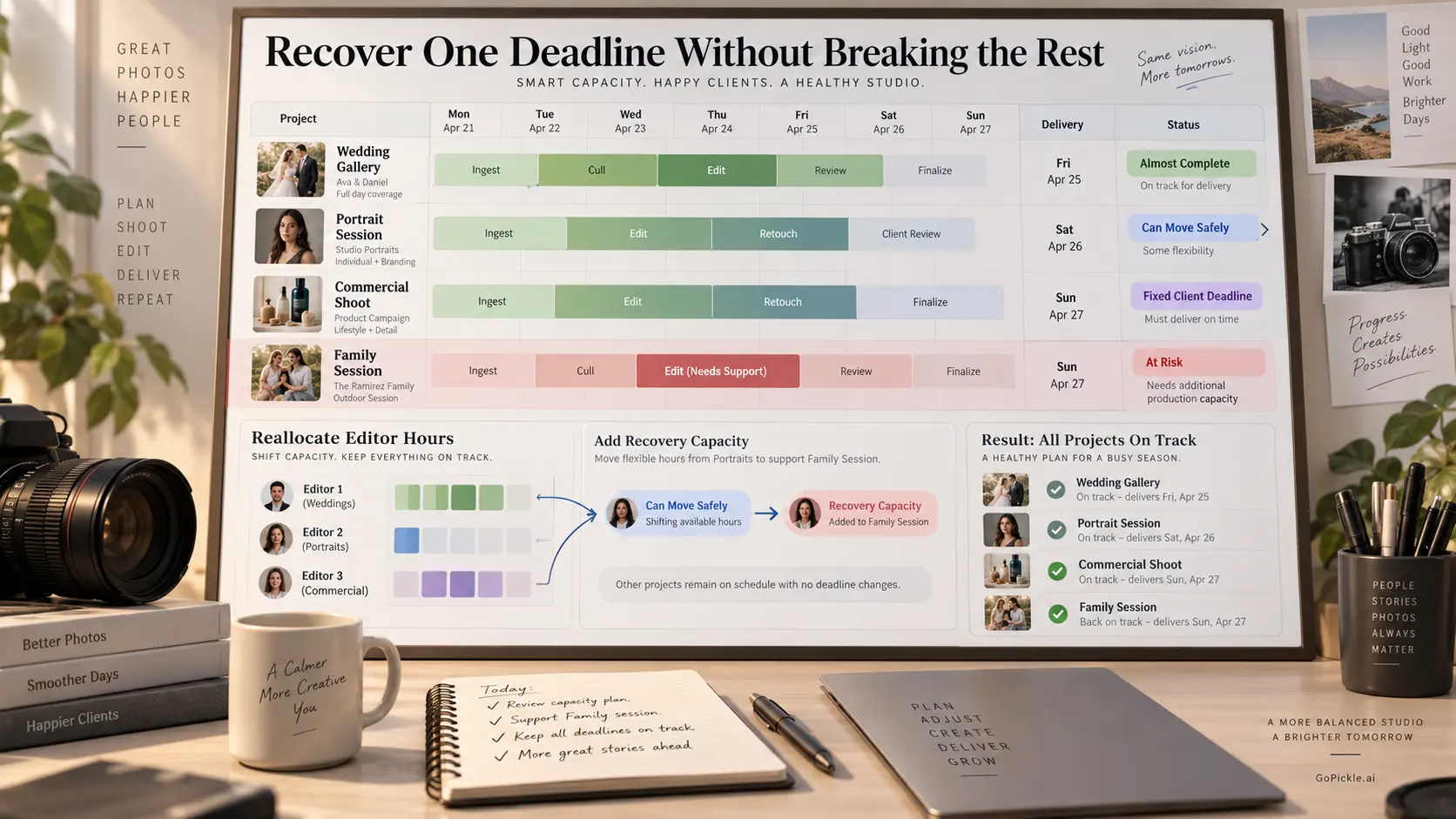
If the workload simply exceeds available production hours, acknowledge that as a capacity problem. Reordering work cannot create hours that do not exist. The recovery options may involve reallocating internal work, using a trusted external editor, postponing non-client production, reducing interruptions or changing future booking capacity. What matters is that the choice is deliberate rather than allowing deadlines to fail one after another.
Keep communicating until the reset delivery is complete
A revised deadline should reduce communication, not create another period of silence.
If the new date is close, the client may not need another update before delivery. If the revised period is longer, establish an appropriate checkpoint. A client waiting several additional weeks for wedding photos should not have to wonder whether the new plan is still alive.
Updates should communicate change, not manufacture activity. There is little value in sending “still editing” every two days if nothing material has happened. A useful update confirms that the revised plan remains on track, reports a meaningful milestone or tells the client promptly if another issue has changed the forecast.
Most importantly, do not let the replacement date quietly expire. If a second risk appears, address it before that date in exactly the same way: reassess the work, make a decision and communicate clearly.
Trust usually recovers through kept commitments, not increasingly elaborate apologies.
Post-mortem the delay after the photographs are delivered
Once the gallery has been sent and the immediate pressure disappears, it is tempting to move straight to the next shoot. That loses the most useful operational information the delay created.
Record why the job became late.
Was the original turnaround too aggressive? Was editing effort underestimated? Did the studio accept too many shoots during the same period? Was a client-dependent stage poorly communicated? Did one editor become a bottleneck? Did file handoff take too long? Did a sneak peek consume production time that had not been planned? Did the studio only notice the problem after the client contacted it?
Then classify the cause as something you can improve. The next action might be changing the delivery promise for that package, introducing an internal editing deadline, reviewing the production queue weekly, tightening client-selection reminders, adding external editing capacity or reducing peak-season booking volume.
After delivery, a structured photography client feedback survey can also reveal how the delay actually affected the client experience. The useful question is not simply whether they liked the photographs. You want to know whether communication remained clear, whether they understood the revised timeline and where uncertainty appeared.
Late delivery becomes a bigger problem when the studio stops managing it
Delays happen in photography businesses because creative production contains uncertainty. A wedding produces more work than expected. A revision expands. An editor becomes unavailable. Client selections arrive together. Equipment or upload problems consume a day that was supposed to be productive.
The professional response is not to pretend those situations never occur. It is to detect risk while there is still time to act.
At GoPickle, we think the safest recovery sequence is straightforward: identify the threatened promise, diagnose the real blocker, calculate a defensible new date, tell the client before they have to chase you, protect the other work already sold and review the cause once delivery is complete.
A late photo delivery does not have to become an uncontrolled client-service failure. But the recovery needs to exist in the production plan, not only in the apology message.